

Export Quality | Made in India
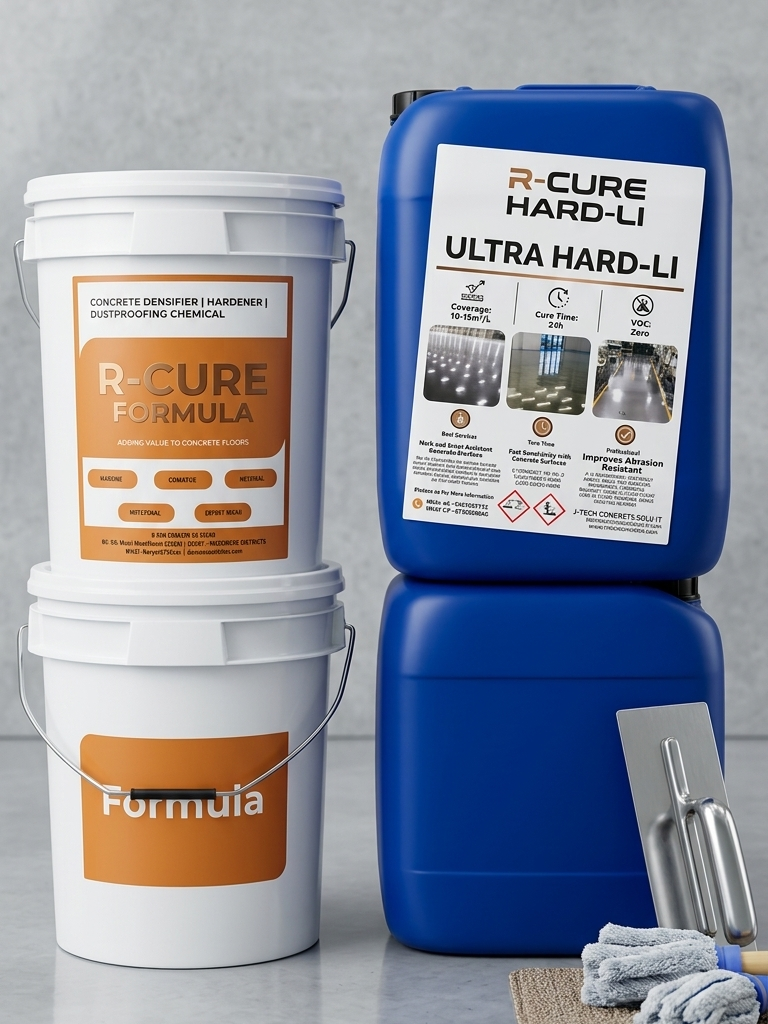
R Cure Formula Densifier
Reactive Collidial Silicate Concrete Densifier & Liquid Floor Hardener
Product Overview
Engineered Chemistry for Permanently Hardened Concrete
R Cure Formula Densifier is a reactive silicate concrete densifier and liquid floor hardener engineered to penetrate deep into cured concrete. On contact, its active silicate chemistry reacts with the free lime (calcium hydroxide) naturally present in the slab, converting it into hardened calcium silicate hydrate (C-S-H) gel within the pore structure.
This reaction fills and densifies the capillary network, producing a harder, tighter and more abrasion-resistant surface. The result is a floor that resists dusting, rejects water and oil penetration, and develops a progressively brighter sheen under foot and vehicle traffic.
Unlike topical coatings and film-forming sealers, R Cure Formula becomes a permanent part of the concrete itself. It cannot peel, flake or wear away, because the hardening occurs chemically inside the slab rather than as a layer sitting on top of it.
Available in ready-to-use and concentrated grades, R Cure Formula is formulated specifically for Indian concrete conditions and applied easily by low-pressure sprayer or roller. It is equally suited to new slabs and the restoration of old, worn and dusting floors across industrial, commercial and infrastructure environments.
Key Benefits
Deep Chemical Penetration
Active silicate chemistry travels deep into the pore structure, hardening the slab from within.
Increased Surface Hardness
C-S-H gel formation measurably raises surface hardness and abrasion resistance.
Eliminates Surface Dusting
Binds loose particles permanently, stopping the chalky dust that plagues bare concrete.
Reduces Water & Oil Permeability
Tightened capillaries resist liquid ingress, protecting the slab and easing clean-up.
No Peeling or Wear-Off
Unlike surface coatings, densified concrete cannot delaminate, peel, or wear off — performance is permanent.
Compatible with All Concrete Types
Works on new pours, aged slabs, and high water-cement ratio mixes common in Indian construction.
Technical Specifications
Full product data for R Cure Formula Densifier & Liquid Floor Hardener
| Product Properties | |
|---|---|
| Chemistry | Colloidal Silica /Hybrid Silicate |
| Form | Liquid Concentrate & Ready-to-Use (RTU) |
| Dilution (Concentrate) | 1:3 with water for Concentrate |
| Dilution (RTU) | Ready to use, no dilution required |
| Color | Clear / Colorless |
| Coverage Rate | 4–5 sq mt per liter |
| Application Method | Spray, roller, or brush; flood and squeegee |
| Penetration Depth | 3–5 mm (typical on open concrete) |
| pH | 11–12 (alkaline) |
| Application & Storage | |
|---|---|
| Drying Time | 1–2 hours (surface dry); 24 hours full cure |
| Foot Traffic | After 4–6 hours |
| Heavy Traffic / Machinery | After 24 hours |
| Shelf Life | 24 months (sealed container) |
| Storage | 5°C – 40°C, away from sunlight |
| Packaging | 20L,60L, 200L |
| VOC Content | <50 g/L (Low VOC) |
| Compatible Substrates | New and old concrete, screed, terrazzo |
How It Works
4 simple steps to a permanently hardened concrete floor
01
Clean, Grind & Prepare
Remove all dust, grease, curing compounds, and other contaminants. Ensure the substrate is dry and open-pored prior to application. Clean new floors using mechanical floor-cleaning pads in sequence: 60-grit followed by 100-grit. Start from Metal Bond if require
02
Apply Densifier
Apply R Cure Formula to the concrete surface by spray or pour method ensuring uniform coverage, and keep wet surface for 20–30 minutes. Allow the surface to cure dry for 8–10 hours. An additional re-coat may be required on highly dust-prone or porous floors.
03
Deep Penetration & Hardening
Active silicate penetrates deep into concrete capillaries, reacting with Ca(OH)₂ to form C-S-H crystals — permanently filling pores and hardening the surface. The reaction continues internally, progressively densifying the matrix from within.
04
Polishing To Achieve Shine
Begin polishing the cured surface using diamond tooling in ascending grit sequence — from coarse to fine — to achieve the desired gloss level. Continue until a uniform, dense, and reflective finish is attained across the entire slab.
Where It Works Best
R Cure Formula Densifier is trusted across industrial and commercial concrete applications
🏭
Industrial Warehouses
High-traffic floors where dust control and surface hardness are critical
🚗
Parking Structures
Withstands tyre abrasion, oil, and constant vehicle movement
🏗️
Manufacturing Plants
Chemical-resistant, dust-proof floors for production environments
🏢
Commercial Flooring
Retail, showrooms, and office floors requiring polished aesthetics
🛣️
Road & Infrastructure
Bridge decks, road surfaces, and public infrastructure slabs
🏠
Residential Floors
Garage floors, basements, and utility areas needing durable finish
Frequently Asked Questions
Everything you need to know before you apply
Product remains optically clear with zero visual profile post-cure. No topical sheen, film deposition, or surface residue. Chemical reaction occurs within pore matrix; densification is entirely subsurface. Suitable for applications requiring unaltered aesthetic appearance.
Light pedestrian traffic permissible after 4–6 hours surface-dry condition. Full-cure strength development and mechanical loading capacity achieved at 24 hours, per ISO 1920 curing protocol. Recommended minimum 48-hour cure interval before motorized vehicle operation or heavy equipment placement.
Application feasible on concrete ≥24–48 hours post-placement, following initial set and surface hardening. Verify compressive strength development (minimum 5–7 MPa) before application. Green concrete with high free water content may exhibit reduced penetration efficiency; allowsurface drying prior to treatment.
Ready-to-Use (RTU) formulation requires zero pre-treatment; direct spray or roller application at manufacturer’s optimized silicate concentration. Concentrate variant diluted 1:3 (v/v) with potable water prior to application. Concentrate provides economic advantage for large-area projects (>500 m²) and permits on-site formulation flexibility per site-specific porosity assessment.
Substrate compatible with epoxy, polyurethane, acrylic, and polyaspartic coating systems when cure window extended to minimum 48–72 hours post-application. Fully densified surface provides superior mechanical adhesion profile. Mandatory: conduct ASTM D3359 adhesion pull-test on representative site sample prior to full-system specification.
Single-coat application achieves primary densification on concrete with normal porosity (water absorption 10 years), high water-cement ratio mixes (w/c >0.60), or weathered surfaces exhibiting elevated capillary porosity. Apply second coat minimum 24 hours post-initial cure.
Substrate must achieve ISO 8501-1 Sa 2.5 cleanliness minimum; remove oil, grease, curing compounds, laitance, and atmospheric contamination. Mechanical abrasion—grit blasting (Sa 2.5), grinding (80–120 grit), or shot peening—is normative to expose capillary structure and optimize penetration depth. Surface must be dry (≤4% moisture content) at time of application.
Effective on established concrete substrates when subjected to comprehensive surface preparation per ISO 8501. Recommend abrasive preparation (Sa 2.5) and rigorous alkalinity verification (pH >12) to confirm reactive capacity. Aged concrete with sealed or densified prior treatments requires assessment of existing membrane integrity; prefer mechanical removal if present.
VOC content <50 g/L (ASTM D3960) qualifies as low-VOC formulation for enclosed-space application. Water-based composition (non-flammable per ASTM D3278); storage stable at 5–40 °C. Ensure mechanical or natural ventilation (minimum 6 air changes/hour) during application and cure phases. Product poses no acute health hazard; standard occupational hygiene practices recommended.
Silicate densification represents irreversible, chemically-bonded hardening—not a topical or removable coating. Once reactive silicates combine with free calcium hydroxide (Ca(OH)₂) to form C-S-H gel, densification persists indefinitely without degradation under normal service conditions. No reapplication protocol required; performance is permanent.

